Safe but not Soft
An excerpt from The Red Angel by G.K. Chesterton, 1909
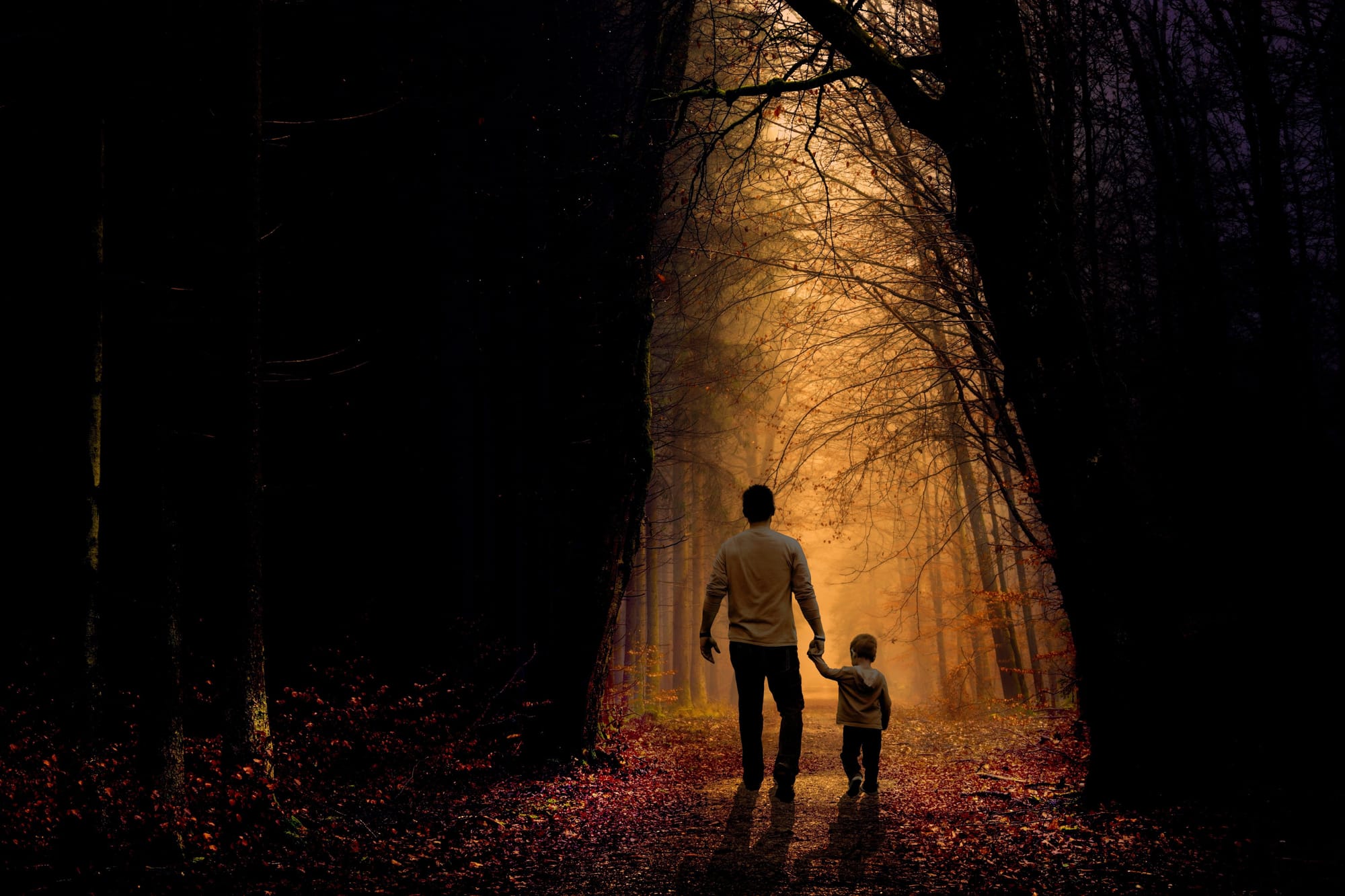
“But a lady has written me an earnest letter saying that fairy tales ought not to be taught to children even if they are true. She says that it is cruel to tell children fairy tales, because it frightens them. You might just as well say that it is cruel to give girls sentimental novels because it makes them cry. All this kind of talk is based on that complete forgetting of what a child is like which has been the firm foundation of so many educational schemes. If you keep bogies and goblins away from children they would make them up for themselves. One small child in the dark can invent more hells than Swedenborg. One small child can imagine monsters too big and black to get into any picture, and give them names too unearthly and cacophonous to have occurred in the cries of any lunatic. The child, to begin with, commonly likes horrors, and he continues to indulge in them even when he does not like them. There is just as much difficulty in saying exactly where pure pain begins in his case, as there is in ours when we walk of our own free will into the torture-chamber of a great tragedy. The fear does not come from fairy tales; the fear comes from the universe of the soul…
…The timidity of the child or the savage is entirely reasonable; they are alarmed at this world, because this world is a very alarming place. They dislike being alone because it is verily and indeed an awful idea to be alone. Barbarians fear the unknown for the same reason that Agnostics worship it—because it is a fact. Fairy tales, then, are not responsible for producing in children fear, or any of the shapes of fear; fairy tales do not give the child the idea of the evil or the ugly; that is in the child already, because it is in the world already. Fairy tales do not give the child his first idea of bogey. What fairy tales give the child is his first clear idea of the possible defeat of bogey. The baby has known the dragon intimately ever since he had an imagination. What the fairy tale provides for him is a St. George to kill the dragon.”
Safe?
“I just wish I didn’t have to worry about it.”
Whether they’re talking about cartoons, books, or video games, concerned parents have uttered these words with ever increasing frequency across America. I’ve said the very same words. As my daughter grew, she quickly picked her favorite forms of entertainment, as all kids do. My wife and I made it a habit to watch the shows and read the books to ensure she was not coming into contact with inappropriate material. As we watched, the places we found objectionable content were astonishing. We were new parents, it was our first kid, and while we knew the problem existed, we didn’t know just how bad it was. It seemed to be baked into everything. Nowhere was just safe. As an example, Pete the Cat, a very popular children’s book and cartoon series, was an early favorite of my daughter’s. It was fun, musical, and explored simple childhood concepts like trying new foods. It also includes a homosexual couple. We did not continue with Pete the Cat.
Fortunately, these days, the options are ever increasing for Christian families looking for safe content for their children. Additionally, there are growing databases that keep track of media content (such as Plugedin.com), helping parents parse through the tangled jungle of modern media.
Content published under the Regeneration Publishing name will always be fundamentally Christian - suffused with Christian virtues and constructed from Christian themes. In a word - Safe.
Soft?
With the desire to produce material that is safe, the unintended consequence is often that the material is also soft. I don’t just mean inoffensive. I mean weak, lacking conflict, devoid of artistic merit, limp-wristed, preachy, pillowy, milquetoast content that teaches nothing because it says nothing.
As I learned to read and began to read to learn, my parents blessed me with access to a small family library. I would lay on the carpet in the play room and look over the spines, some ponderous, some a mere pamphlet, and I was allowed to read every one* if I so desired. One of the books I read during those formative years (to provide a positive example against the negative one listed above) was Mossflower by Brian Jacques. Wicked rulers, mystical heroes, magic swords, and across the whole of the story, peril and violence. Jacques was careful throughout this book (and the many, many sequels) not to glory in the bloodshed, nor did he ever sink into gory descriptions. By fang, claw, sword, spear, and slingstone, however, the characters of his books fought and died. Sacrifice had value, courage had consequence. It made the books worth reading.
Obviously, there are levels of conflict appropriate for different age ranges. It is necessary, however, that we do not forget that conflict is necessary for story, for adults and also for toddlers.
Regeneration
The logical precedent to regeneration is damage, illness, death. In order for one to be regenerated, one must first suffer a wound. This world is drowned in blood but, good - news for us - Jesus is the ark. He takes us from a state of death and returns us to life. He regenerates us. That is the prime story in history, across all of creation. Descending into death then a glorious resurrection and return to life, a life fuller than the original that was lost. That is a story worth telling. It was so worth telling that God Himself wrote it and then lived it.
If that is the pattern of the ultimate story, why would I ever try to tell any other? It spans from the highest heights to the lowest lows and encompasses everything in between. My promise to you is to tell stories in this pattern. Stories that will be safe but not soft. From children’s stories to novels, my stories will challenge you to pursue examples of virtue but they will also have you to wrestle with evil. In every case, they will remind you that dragons can indeed be slain.
~~~~~~~~~~~~~~~~~~~~~~~~~~~~~~~~~~~~~~~~~~~~~~~~~~~
*The only refusal I ever suffered was dealt out by my father when I picked The Man-Kzin Wars by Larry Niven. The cover had space-tigers wearing battle suits, flying starships, and shooting laser guns. I was perhaps 12. It was the coolest thing I’d ever seen. It stung at the time, but my dad was right in making me wait a bit longer for that particular series.